
SEO for Beginners: How Businesses Can Rank on Google and Get More Customers
If you run a business today, your customers are already searching for you on Google… whether you’re there or not. Search Engine Optimization (SEO) is how you show up when they look. It’s not magic, and it’s not just for tech people. With the right basics, any business can start ranking higher and getting more customers from Google.
Let’s walk through SEO in a simple, practical way, focusing on what actually works for beginners.

1. What Is SEO (Really)?
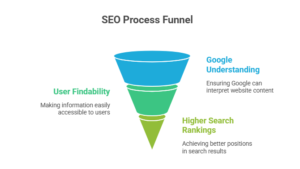
SEO (Search Engine Optimization) is the process of improving your website so that:
-
Google can understand what it’s about.
-
Users can easily find the information they need.
-
Your pages appear higher in search results for relevant keywords.
In short: SEO helps you get free, ongoing traffic from Google instead of paying for every click through ads.
Why SEO Matters for Businesses
-
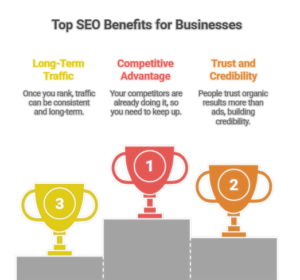
Your competitors are already doing it.
-
People trust organic (non‑ad) results more.
-
Once you rank, traffic can be consistent and long‑term.
-
It works for almost any type of business: local shops, e‑commerce, coaches, SaaS, agencies, etc.
Think of SEO as building a digital “storefront” on the busiest street in the world: Google’s first page.
2. How Google Decides Who Ranks
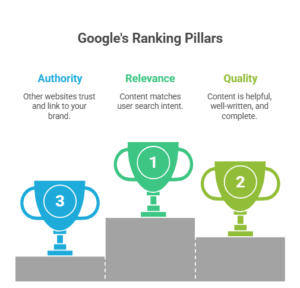
Google wants to show the best possible answer to each search. To do that, it looks at hundreds of factors, but for beginners, you can focus on three big pillars:
-
Relevance – Does your content match what the user is looking for?
-
Quality – Is your content helpful, well‑written, and complete?
-
Authority – Do other websites trust and link to you?
If you create content that matches what your ideal customer is searching for, make it genuinely helpful, and build trust around your brand, you’re already doing SEO at a decent level.
3. Step 1: Understand Your Audience and Their Keywords
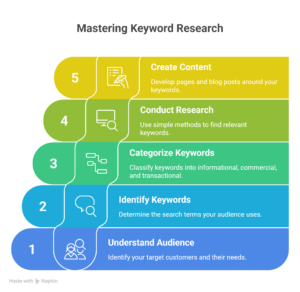
SEO starts before you write anything. You first need to know:
-
Who are your customers?
-
What problems do they have?
-
What are they typing into Google when they look for help?
These searches become your keywords.
Types of Keywords
-
Informational keywords – People want answers or education.
-
Examples:
-
“how to fix leaking tap”
-
“best running shoes for beginners”
-
“what is SEO for small business”
-
-
-
Commercial keywords – People are researching what to buy.
-
Examples:
-
“best dentist in [city]”
-
“project management software comparison”
-
“top digital marketing agencies”
-
-
-
Transactional keywords – People are ready to buy or contact.
-
Examples:
-
“book accountant near me”
-
“buy wireless headphones online”
-
“hair salon appointment [city]”
-
-
You want a mix of these, but transactional and commercial keywords are most directly tied to getting customers.
Simple Keyword Research for Beginners
You don’t need fancy tools at the start. Here are easy methods:
-
Google autocomplete: Start typing a phrase and see what Google suggests.
-
People Also Ask boxes: These give real questions people are asking.
-
Related searches at the bottom of Google’s results page.
-
Look at competitor websites and see the topics they cover.
Write down a list of phrases your customers might search for, such as:
-
“plumber in [your city]”
-
“family lawyer for divorce”
-
“organic coffee beans online”
-
“SEO services for local businesses”
These will become the topics of your pages and blog posts.
4. Step 2: Optimize Your Website Pages (On‑Page SEO)
Once you know your keywords, the next step is to optimize your actual pages. This is called on‑page SEO.
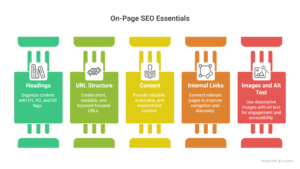
Key On‑Page SEO Elements
-
Page Title (Title Tag)
This is the blue, clickable headline you see in Google results.
-
Include your main keyword.
-
Make it clear and compelling for humans, not just search engines.
-
Example:
-
Instead of: “Home | Company Name”
-
Use: “Affordable Plumber in Chicago | 24/7 Emergency Plumbing”
-
-
-
Meta Description
This is the short description under the title in Google results.
-
It doesn’t directly impact ranking much, but it affects clicks.
-
Use your keyword naturally and a call to action.
-
Example:
-
“Looking for a reliable plumber in Chicago? We offer 24/7 emergency plumbing, fast response, and fair pricing. Call now for a free quote.”
-
-
-
Headings (H1, H2, H3)
Headings help organize your content.
-
Use one H1 per page (main title on the page).
-
Break your content into sections with H2 and H3.
-
Include keywords where natural, but don’t stuff.
-
-
URL Structure
-
Keep URLs short, readable, and keyword‑focused.
-
Example:
-
Good: /emergency-plumber-chicago
-
Bad: /page-id-123?ref=home
-
-
-
Content Itself
Your content should:
-
Answer the user’s main question clearly.
-
Be easy to scan with headings, bullet points, and short paragraphs.
-
Include your keyword and related terms naturally.
-
Provide real value: tips, explanations, examples, visuals.
Remember: write for people first, Google second.
-
-
Internal Links
-
Link from one relevant page on your site to another.
-
Example: a blog post on “how to fix low water pressure” links to your “plumbing services” page.
-
This helps users navigate and helps Google discover and understand your pages.
-
-
Images and Alt Text
-
Use images to make content engaging.
-
Use descriptive file names and alt text (for accessibility and context).
-
Example alt text: “technician repairing a leaking kitchen sink”
5. Step 3: Optimize for Local Searches (Local SEO)
If you have a physical location or serve certain areas (restaurants, salons, plumbers, dentists, local shops), Local SEO is crucial.
Google Business Profile
Create and optimize your Google Business Profile (formerly Google My Business):
-
Use your exact business name.
-
Add correct address, phone, website, and opening hours.
-
Choose accurate business categories (e.g., “Italian restaurant”, “family lawyer”).
-
Add photos of your location, team, and products.
-
Ask happy customers to leave reviews and reply to those reviews.
This profile helps you show up in:
-
The Map Pack (top map results).
-
The right‑hand knowledge panel.
-
Google Maps searches.
Local SEO Tips
-
Include your city/region in important pages and headings.
-
Create a “Contact” or “Locations” page with your full address and map.
-
Make sure your Name, Address, and Phone (NAP) are consistent across the web (website, social profiles, directories).
-
Get listed in local directories relevant to your industry (chambers of commerce, industry associations, etc.).
Local SEO can be a huge driver of real‑world customers, not just website traffic.
6. Step 4: Create Helpful, Customer‑Focused Content
Content is where SEO and customer trust meet. You don’t have to be a blogger to do this well; you just have to be helpful.
What Kind of Content Should a Business Create?
Ask yourself: what are my customers struggling with?
Examples by industry:
-
Plumber
-
“How to prevent pipes from freezing in winter”
-
“Signs you need to replace your water heater”
-
-
Accountant
-
“Small business tax checklist”
-
“Common tax deductions owners forget about”
-
-
Fitness coach
-
“Beginner workout plan with no equipment”
-
“How to stay consistent with workouts when you’re busy”
-
-
Online store
-
“How to choose the right running shoes for your foot type”
-
“Gift ideas for coffee lovers under $50”
-
By answering real questions, you:
-
Attract visitors from Google.
-
Build trust and authority.
-
Warm up potential customers before they even contact you.
Content Tips for SEO Beginners
-
Don’t copy others. Put your own voice and experience into it.
-
Aim to be clear, not fancy. Simple language wins.
-
Use examples, real stories, and practical steps.
-
Include a gentle call to action:
-
“Need help with this? Contact us for a free consultation.”
-
“Ready to get started? Shop our best‑selling products here.”
-
7. Step 5: Build Authority with Backlinks
A backlink is a link from another website to yours. To Google, this is like a vote of confidence: “We trust this site.”
The more quality backlinks you have (especially from reputable sites in your niche), the more authority your site can gain.
Ways Beginners Can Earn Backlinks (Without Spam)
-
Create link‑worthy content
-
In‑depth guides, checklists, or resources that others naturally want to reference.
-
-
Local partnerships
-
Sponsor local events and ask for a link from their website.
-
Collaborate with other local businesses and share each other’s content.
-
-
Industry associations and directories
-
Join professional organizations that list members on their websites.
-
-
Guest posts and contributions
-
Write helpful articles for blogs or magazines in your niche.
-
-
Press and media
-
Share newsworthy updates: new openings, awards, charity events. Send to local media or bloggers.
-
Avoid:
-
Buying cheap backlinks.
-
Using automated link schemes.
-
Spamming comment sections with your URL.
Google is good at spotting manipulative tactics. Focus on real relationships and real value.
8. Step 6: Make Sure Your Site Is Technically Friendly
You don’t need to be a developer, but you should make sure your website is not blocking your SEO progress.
Key Technical SEO Basics
-
Mobile‑Friendly Design
-
Most users search on phones.
-
Your site should be easy to read and navigate on mobile: text large enough, buttons easy to tap, no horizontal scrolling.
-
-
Fast Loading Speed
-
People leave slow sites quickly.
-
Common improvements:
-
Compress images.
-
Remove unnecessary plugins or scripts.
-
Use a reliable hosting provider.
-
-
-
Secure Connection (HTTPS)
-
Your site should use HTTPS (not HTTP).
-
This is a trust signal for both users and search engines.
-
-
Clear Navigation and Structure
-
Users should be able to find what they need in a few clicks.
-
Use logical menus and categories.
-
Avoid broken links (404 errors).
-
-
Indexing
-
Make sure your important pages aren’t accidentally blocked from search engines by noindex tags or misconfigured settings.
-
Most modern website builders handle this fine by default, but it’s worth checking.
-
If anything here feels too technical, a basic conversation with a web designer or developer can go a long way. You don’t have to do it all yourself—you just need to understand why it matters.
9. Step 7: Track Your Results and Improve Over Time
SEO isn’t a “set it and forget it” job. It’s more like going to the gym: progress builds over time.
What to Track
-
Organic traffic – How many people are coming from Google?
-
Top pages – Which pages are getting the most visits?
-
Keywords – What are people searching to find your site?
-
Leads and sales – How many inquiries, calls, bookings, or orders come from your website?
You can use free tools like Google Analytics and Google Search Console to monitor these, or even the stats provided by your website platform.
How to Use the Data
-
If a blog post is getting visitors but not leads, improve the call to action.
-
If a service page gets few visits, optimize the title, content, and internal links.
-
If people leave quickly (high bounce rate), improve the content and design.
SEO is about continuous improvement. Small, consistent tweaks can make a big difference over months.
10. Common SEO Mistakes Beginners Should Avoid
To stay on the safe side, watch out for these:
-
Keyword stuffing
Repeating the same phrase unnaturally many times. It looks spammy and hurts readability.
-
Thin, low‑value content
Pages with very little information or obvious fluff. Always aim to genuinely help.
-
Ignoring local SEO
If you’re local, but you don’t optimize your Google Business Profile or add your location clearly, you’re leaving money on the table.
-
Copying content from other sites
Duplicate content can harm trust and ranking. Use your own words and experience.
-
Focusing only on rankings, not conversions
Traffic alone isn’t the goal. You want customers. Make sure your site makes it easy to contact you or buy.
-
Giving up too early
SEO is a long‑term strategy. You may not see big changes in a few weeks. Think in months, not days.
11. A Simple SEO Roadmap for Beginners
If you feel overwhelmed, here’s a straightforward plan you can follow over the next few months.
Month 1: Foundations
-
Define your ideal customer and list the questions they ask.
-
Make a simple keyword list based on those questions and your services.
-
Optimize your main pages:
-
Homepage
-
Services or product pages
-
Contact page
-
-
Set up or update your Google Business Profile (for local businesses).
Month 2: Content and Local Presence
-
Create 2–4 helpful blog posts or guides that answer common customer questions.
-
Add internal links between related pages on your website.
-
Ask happy customers for Google reviews.
-
List your business on relevant directories and associations.
Month 3 and Beyond: Authority and Optimization
-
Reach out to local or industry sites for collaboration or guest content.
-
Improve your site speed and mobile experience.
-
Analyze what’s working (which pages get traffic) and refine content.
-
Keep publishing valuable content regularly (even 1 quality post per month helps).
This is realistic and manageable for most small to medium businesses.
12. How SEO Brings You More Customers
Here’s how it all ties together in real life:
-
A potential customer has a problem.
-
“emergency plumber near me”
-
“best CRM software for small business”
-
“wedding photographer [city]”
-
-
They go to Google and search.
-
Your optimized page appears on the first page (or in the map results).
-
Your clear title and description convince them to click.
-
Your helpful, professional content builds trust.
-
Your clear calls to action make it easy to contact or buy.
-
They become a lead or a paying customer.
Do this consistently for many keywords, and SEO becomes one of your most powerful marketing channels—bringing you warm, high‑intent prospects every day.
Final Thoughts
SEO for beginners doesn’t have to be complicated. You don’t need to know every technical detail or chase every algorithm update.
If you:
-
Understand your audience and what they search for.
-
Create clear, helpful content around those topics.
-
Optimize your pages in a simple, structured way.
-
Build trust and authority over time.
-
Stay patient and consistent.
…you’ll be ahead of many businesses that either ignore SEO or try to “hack” it.